Showing posts with label Book Review. Show all posts

Tuesday, June 17, 2008

Twilight

Last night, about 3am, I finished Stephenie Meyer's novel Twilight (The Twilight Saga, Book 1). It was fantastic. I'm quite obsessed now and I must get my hands on the 2 other books in the series that have been published, New Moon and Eclipse (Breaking Dawn comes out 2 August 2008).

I had heard about the books from students, but hadn't paid much attention until the past week or so. Then, I bought a copy of Twilight and managed to save it until Saturday night. I had a headache all Saturday, which should have sent me to bed early. I couldn't resist beginning the book, though, and ended up reading until 3am (it was quite that good).

It was very hard not to give in and just read the novel in one night. I managed to make myself only read it in bed, before I went to sleep (I did sneak in 3 chapters yesterday afternoon), and stayed up until 3am 3 nights in a row finishing it, listening to DeBussy's "Clair de Lune." I must, must, must go get the other 2 books ASAP!

Twilight is set in tiny Forks, Washington, which is located near Port Angeles. It is about Bella Swan, who moves back to Forks to live with her father. She's used to the hot sun of Phoenix and cannot like the constant clouds and rain. Her first week at school she sees a very interesting group of fellow students, all beautiful beyond belief, sitting at a lunch table with trays of food but not eating anything. One boy in particular, the one with bronze hair, strikes her fancy, and, though he stares at her, seems to dislike her.

Bella finds out these are the Cullens, a group of foster children who live with Dr. Carlisle and Esme Cullen. The one with bronze hair is named Edward Cullen and he ends up saving Bella's life in a way that seems impossible. Bella and Edward strike up a sort of friendship/romance and Bella eventually realizes that Edward and the Cullens are vampires. Edward ends up telling her about the family and how they do not drink human blood, only animal. The difficulty is that Bella's scent is the most beautiful Edward has ever smelled. He adores and loves her and cannot bear to hurt her.

Bella and Edward's romance is one fraught with peril. She is the most tempting thing in the world for Edward but cannot resist being with her. He is the most beautiful and wonderful man in the world but could harm her without meaning to or else break her heart by staying away. Yet, he cannot stay away.

I absolutely loved this novel. There are only a few "vampire" novels that I like and they are usually the ones that are more romance/story than sci-fi. Twilight is one of those, very well-written, funny, heart-wrenching, interesting, and moving. The author, Stephenie Meyers, is a fan of Jane Austen, William Shakespeare, and Charlotte Bronte, to name a few, all favorites of mine. I read that she named Edward "Edward" because it was an old-fashioned, romantic name and for Edward Rochester in Jane Eyre and Edward Ferrars in Sense and Sensibility.


Twilight, the movie, will be in theaters 12 December 2008, starring Robert Pattinson, who played Cedric Diggory in HP and the Goblet of Fire, as Edward Cullen. The official movie site is here.

Stephenie Meyer's site with lots of great items is here.

Go read Twilight!

Thursday, June 05, 2008

Book Review: Emma & Knightley

When Emma and Knightley marry at the end of Jane Austen's Emma, Emma is a very young 21 or 22 years old. While she has been mistress of her father's house for a number of years, she has never had to balance her role as a daughter caring for her (hypochondriac) father with her new role as Mr. Knightley's wife. I for one always wondered how their relationship continued to develop after the close of Austen's novel.

Fortunately for us, Rachel Billington's novel Emma & Knightley: Perfect Happiness in Highbury: A Sequel to Jane Austen's Emma brings the reader into Emma and Knightley's life after their marriage.

As is usual, I am sure, the Knightleys have their little difficulties adjusting to married life. Knightley has agreed to live to live at Hartfield, rather than his home of Donwell Abbey, so that Mr. Woodhouse will not be disturbed too much. Emma is trying to figure out how to relate to Knightley as her husband, rather than the beloved older neighbor. And he is trying, as always, to help Emma continue to grow into a well-rounded, thoughtful lady, and to help her see him as the love of her life, not just a loving familiar face.

Their lives are further complicated by the difficulties of those around them. Mrs. Bates has died, leaving poor Miss Bates alone. Jane Fairfax Churchill dies, leaving a bereaved (and half-mad) Frank Churchill with a newborn. Knightley's brother John has major financial difficulties, which they hide, for a time, from Emma's sister Isabella. And, it seems as if every couple is having children, except the Knightleys.

I confess, while I love Emma, it is probably my least favorite of Jane Austen's novels, partly because Emma does not seem to grow as much as a person as the other Austen heroines do. That's why I am delighted that Billington did such an excellent job on Emma & Knightley. Her novel continues Emma's growth as a human being and a woman, rather than a girl, and shows how the Knightleys figure out how to relate to eachother as spouses and settle into their marriage.

Billington also did a good job continuing the secondary characters Austen wrote. The Westons are lovely and, naturally, expanding their family. Miss Bates is her usual chatty self, but ends up providing perfect companionship for Mr. Woodhouse. Frank Churchill is a selfish cad and causes Emma difficulties. Billington also introduces new characters, including Mrs. Philomena Tidmarsh, who challenges some of Emma's ideas.

I was also happy with the fact that Billington did not try to change the characters or make them behave in ways inconsistent with their Austen-written characters. The plot was well-developed and satisfying.

Emma & Knightley is a delightful continuation of a beloved book. I recommend it for any Austen fan and anyone interested in following the development of Emma and Knightley's marriage. You can find it at any bookstore or through Amazon.com.

Book Information: Emma & Knightley: Perfect Happiness in Highbury: A Sequel to Jane Austen's Emma by Rachel Billington (Sourcebooks Landmark; ISBN: 1-4022-1207-0; $14.95; 368 pages; paperback)

Tuesday, April 22, 2008

Book Review: The Darcys Give A Ball

Elizabeth Newark's novel The Darcys Give a Ball is subtitled "A gentle joke, Jane Austen style" and it is an amusing little continuation of Jane Austen's novels. While the title focuses on the Darcys (I love the Darcys), the book largely concerns the Collins and their interactions with the Darcys.

As the back of the book says,

Whatever will Mr. Darcy say . . . when his second son falls in love with Mr. Collins's daughter; his first-born, Juliet, is almost lured into an elopement; and Georgiana's timid daughter Lucy becomes the new target of Miss Caroline Bingley's meddling?
The book is divided into a prologue and 13 chapters of varying lengths, each beginning with an appropriate Jane Austen quote. The first three chapters are sort of visits, by the reader, to Hunsford Parsonage, Longbourn, and Pemeberley. At each place, the reader learns how the lives of the inhabitants have spent the last 25 or so years, their children, thier occupations, and their plans.

Mrs. Darcy and Mrs. Bingley decide to hold a ball at Pemberley, now that their children have reached marrying age. They invite all sorts of characters from other Jane Austen novels (and some of their children) to attend: Brandons, Wentworths, Bertrams, Knightleys, Elliots, Churchills, and more. Miss Caroline Bingley is still trying to make matches. Various young people are meeting and falling in love (to the dismay or happiness of their parents). Much of the first half of the book is dedicated to preparing for and arriving at the ball. The second half of the book takes place at Pemberley and at the ball, where lots of things are happening. It was very interesting to see all the characters again, meet their children, and see which characters would pair up.

The Darcys Give a Ball is a pleasant book and a very quick read. It was enjoyable to "see" many of the familiar JA characters again and "meet" their children. As usual, any number of the children from different novels pair up by the end of the book. Most of the characters remain true to form. Elizabeth Darcy is a rather more snobbish than I would expect her to be, but mellows by the end of the novel. Mr. Darcy, however, is exactly as I would expect him to be after 20+ years of marriage to Elizabeth: a very wonderful man who, though very rich and high in the world, knows how to make everyone feel welcome.

I enjoyed reading The Darcys Give a Ball. Although it wasn't exactly as I would expect Pemberley and my favorite characters to be after years and years, I was happy to read it as "a gentle joke, Jane Austen style," and laugh at and with the characters. If you can't get enough JA adaptations, I recommend you pick up a copy of The Darcys Give a Ball by Elizabeth Newark. It is in stores now.

Book Information: The Darcys Give a Ball by Elizabeth Newark (Sourcebooks Landmark; ISBN: 1-4022-1131-7; $12.95; 176 pages; paperback)

Tuesday, April 08, 2008

Book Review: The Watsons and Emma Watson

A whole new round of Jane Austen-inspired books is coming out this spring, beginning, for me, with a fragment written by Jane Austen and taken in a new direction and "completed" by Joan Aiken, The Watsons and Emma Watson.

According to the Republic of Pemberley website, The Watsons,

was written by Jane Austen about 1803-1805, but was not published until 1871, as part of James Edward Austen-Leigh's Memoir (Jane Austen had left it untitled; the title "The Watsons" was provided by Austen-Leigh). It describes Emma Watson's return, after a long absence, to her family, who are on the lower financial fringes of the "genteel". She attracts the interest of a nobleman (and according to tradition in Jane Austen's family, she was later to receive and refuse an offer of marriage from him, and marry a clergyman). It is not clear why Jane Austen did not continue this fragment . . .
Though the fragment and Aiken's story are contained in one edition, I will "split" them briefly to write about Austen's story and probably spend more time explaining the characters in The Watsons, as they are also used in Emma Watson.

I confess: I had not read The Watsons before reading this edition and Aiken's take on it. It felt very odd to be reading something of Jane Austen's that was not as dear and familiar to me as the six completed novels are.

The Watsons begins with Emma Watson, newly returned to her family home, after living with a beloved aunt for 14 years, and being taken by her eldest sister Elizabeth to a nearby village, where she will stay the night with the Edwards family and attend her first ball. Emma's family is rather poor, her father is often ill, and she doesn't really know any of them, brothers Robert and Sam or sisters Elizabeth, Penelope, and Margaret. After the death of her mother, Emma had been sent to live with an aunt, who taught her fine manners and appreciation for nicer things.

As they travel to the ball, Elizabeth tells Emma about their sisters and some of the people she will undoubtedly be meeting at the ball, including the dashing and (possibly) dangerous Tom Musgrave who is "a young man of very good fortune, quite independent, and remarkably agreeable, a universal favourite wherever he goes. Most of the girls hereabouts are in love with him, or have been" (2). Apparently their sister Penelope was hoping he would look her way, but she's a bit troublesome (having encouraged Elizabeth's love to marry elsewhere in the past). Elizabeth hopes Tom dances with Emma, but does not want Emma to fall for him. Also mentioned are the Edwards, whose daughter Sam Watson is hoping to marry, but who might prefer a Captain Hunter; Lord Osborne, his mother, Lady Osborne, his sister, Miss Osborne, and their party, which Emma later learns includes a Mr. Howard, former tutor to Lord Osborne and a clergyman, his sister, Mrs. Blake, and one of her sons, Charles, who is about ten.

At the ball, Emma meets many people, dances, and is admired by the gentlemen. At one point, she shows kindness by dancing with little Charles Blake, when Miss Osborne, who had promised to dance with him goes off with another partner. Emma instantly wins the gratitude of Mrs. Blake, her brother, and the attention of Lord Osborne and Tom Musgrave.

Much of the rest of The Watsons entails Emma's interactions with these characters and her family. Her eldest brother Robert, who is quite stuffy, and his wife Jane (who reminds one of a cross between Fanny Ferrars from S&S and Mrs. Elton from Emma), come for a visit, bringing another sister, Margaret, who appears friendly but is really very petty, dislikes Emma's fine manners (though Emma does not put on airs), and hopes Tom Musgrave will fall in love with her.

The novel fragment ends with Robert and Jane wanting Emma to come for a visit, but Emma would rather stay with her poor father, who is nearing his end.

The Watsons, obviously, cuts off very abruptly, but fortunately for us, Emma Watson by Joan Aiken begins where Jane Austen left off and imagines the fates of Jane's characters. There are many twists and turns, loves and deaths. Emma begins to know her siblings better (which is not always a good thing). Emma becomes friends with Mrs. Blake and has a bit of a crush on Mr. Howard, who might become engaged to Lady Osborne. Her trying sister Penelope shows up married to an older man named Dr. Harding, who is rich, and buys a big local house, which first must be remodeled. This leads to Emma meeting a Captain Fremantle, with whom she feels an instant connection. Tragedy strikes when Emma's father dies. Emma and Elizabeth, who have no income, are to be parceled off to live with their siblings.

The story ends tidily with reunions, marriages, and just rewards. I was quite glad to read it after reading The Watsons because that fragment had no ending. Really, one hardly gets into the story before it abruptly stops. If I hadn't been able to read Emma Watson I would have been quite unsatisified. Aiken did an excellent job of taking Jane Austen's characters and developing them more fully, as characters are often developed in full-length novels. I did not like every twist and turn Aiken introduced, but I was happy with Emma's ending. She deserved nothing less.

I recommend The Watsons and Emma Watson to any Jane Austen fan or anyone who likes an interesting story. It is in bookstores now (and indeed, I saw a copy or two in one last week!) or at Amazon.com. If you read it, do come back and tell us how you liked it!

Book Information: The Watsons and Emma Watson by Jane Austen and Joan Aiken (Sourcebooks Landmark; ISBN: 1-2033-1229-1; $14.95; 256 pages; paperback)

Thursday, March 13, 2008

Vote for the Lost Memoirs of Jane Austen!

The other day I mentioned the Jane Austen's Regency World Awards! Don't forget to vote. You have until 10 May.

I would highly recommend (reading!) voting for The Lost Memoirs of Jane Austen. I got the opportunity to read it in November and give away 2 copies on this blog. It was absolutely fantastic (you can read my review here.).

Thursday, November 15, 2007

And the winners are . . .

I just put all your names into my white and blue teapot and pulled out two randomly.

I am delighted to announce the winners of The Lost Memoirs of Jane Austen Giveaway are Nan and Catherine! Please e-mail me your shipping address to me at TheLadyJane@gmail.com. Lauren at HarperCollins will be sending your books to you! Congratulations!

Thank you to all those who participated in the contest! I was so glad to have you all visit and take the time to comment on my post. I hope you will all read The Lost Memoirs of Jane Austen and come back to visit and tell me what you thought!

Nan and Catherine, enjoy your books!

Come back soon because I will be having another contest within the week!

Wednesday, November 07, 2007

Book Review: The Lost Memoirs of Jane Austen

Our own dear Jane Austen died far, far too young, at the age of 41, leaving behind only 6 completed novels, a handful of other partial novels, juvenilia, and letters. Shortly before she herself died, Jane's beloved sister Cassandra burned an undetermined number of Jane's letters and cut portions out of many others. We will never find out what was in those letters.

But what if we could find out more about Jane's life? What if we could read about the great love of her life? That is what Syrie James has done in her novel The Lost Memoirs of Jane Austen.

According to the "Editor's Forward," written by Mary I. Jesse, of Oxford University, President of the Jane Austen Literary Foundation, an old chest was recently found, walled up at Chawton Manor House. Inside the chest were manuscripts, written in a lady's hand. These manuscripts are the memoirs of Jane Austen.

The memoirs contained in this volume cover a period of years from about 1800-1817. Jane wrote her story because (pgs. 7-8 in the ARC & as exerpted on the website):

there may, I think, be speculation when I am gone. People may read what I have written, and wonder: how could this spinster, this woman who, to all appearances, never even courted—who never felt that wondrous connection of mind and spirit between a man and woman, which, inspired by friendship and affection, blooms into something deeper—how could she have had the temerity to write about the revered institutions of love and courtship, having never experienced them herself?

To those few friends and relations who, upon learning of my authorship, have dared to pose a similar question (although, I must admit, in a rather more genteel turn of phrase), I have given the self-same reply: "Is it not conceivable that an active mind and an observant eye and ear, combined with a vivid imagination, might produce a literary work of some merit and amusement, which may, in turn, evoke sentiments and feelings which resemble life itself?"

There is much truth in this observation.
Indeed. And fortunately for the readers, Syrie James is very good at observation. The Lost Memoirs of Jane Austen begins with Jane's life after she had to leave her beloved home at Steventon and move, with her father, mother, and sister Cassandra to Bath. Five years later Jane's father dies and the women are left without much income. They make extended stays with Jane's brothers and with family friends, but Jane is never settled enough to continue her writing.

On one occasion, while visiting Lyme with her brother Henry, she meets a gentleman who is everything one could ever hope for in a man. His name is Mr. Frederick Ashford. He's handsome, intelligent, charming, friendly, and, really, Jane's soulmate. They plan a picnic with Henry and another couple, but Mr. Ashford is, most unfortunately, called away. Over a year passes before she sees him again. The connection is still there. Jane and Mr. Ashford eventually embark on a lovely relationship, but their will their happiness be complete?

We all know that Jane Austen never married, but she did leave us with six fabulous novels. Apart from the love story, most of The Lost Memoirs of Jane Austen concerns Jane's attempts to reform her earlier stories into the novels that we all know and love today. It couldn't have been easy to maintain one's writing while moving from place to place. Fortunately, Jane's brother Edward gave his mother and sisters a cottage he owned, Chawton Cottage and eventually Jane was able to publish a novel, Sense and Sensibility.

Syrie James made an extensive study of Jane's life & times, novels & letters, and her research shows. It must have been a challenge to stay within the framework of what we know of Jane's life and create the love story, but she did it.

James also made use of Jane's ideas and quotes by creating situations, conversations, characters, and experiences that could feasibly have been Jane's inspiration. It was fun to notice lines similar to beloved ones from any of the novels or to recognize certain people in the people she met in this story. Very clever!

I honestly adored this book and even, for a time, forgot that Jane does not marry Mr. Ashford. He is almost even better than Mr. Darcy (shocking, I know!) because he and Jane have that true, deep connection from the start, without the pride or prejudice. I was very sad to reach the end and know they were never together. I truly wish Jane could married happily, though, as they all say, if she had married, perhaps she never would have written her novels. That would have been a crime against humanity.

I highly recommend The Lost Memoirs of Jane Austen. It was absolutely fabulous. There were lots of little touches that made it special, including "Editor" Mary I. Jesse's footnotes every so often. I already knew much of the information, but readers unfamiliar with the time period would have been very glad to have them. James also included a map of England, with places Jane Austen spent time in highlighted, and an Austen Family Tree, which I referred to throughout the story with great interest. After Jane's "text" ends, there is an "Editor's Afterward" which continues the magic a little longer. Following that, the publisher included an "A+ Author Insights, Extras, & More . . ." This includes a note from the author, Syrie James; a comprehensive list of Jane Austen's works; a chronology of Jane's life; a Q&A with Syrie James (You can read a longer one at her website); Quotations from Jane's works (including some that were used in this novel); and Book Club/Study Guide Questions. You will find lots more interesting items at SyrieJames.com (including a contest).

I hope you will go to your local bookstore or Amazon.com and purchase The Lost Memoirs of Jane Austen. It was an excellent read and I couldn't put it down. If you read it, do let us know what you thought!

Book Information: The Lost Memoirs of Jane Austen by Syrie James (Avon A; ISBN: 0061341428; $13.95; 352 pages; paperback)

Friday, November 02, 2007

Book Review: Mr. Knightley's Diary

Although I had heard of some of Amanda Grange's previous books, such as Mr. Darcy's Diary, I had never read them. Recently, I got the chance to read a copy of Grange's Mr. Knightley's Diary and found that it is a fantastic take on Jane Austen's Emma.

I haven't read Emma in probably a couple of years, so it was refreshing to read the story through Mr. Knightley's eyes. He's a very interesting character and I don't know him as well as Mr. Darcy.

Grange takes the reader into Knightley's (should I be so bold as to address him as such? Emma might not like it.) world and enables us to go with him when he is absent from Highbury. Readers of Emma will remember that Knightley misses Miss Taylor and Mr. Weston's wedding because he is in London. In Mr. Knightley's Diary, the reader is with him! We get to find out what he is doing when he is not with Emma. Haven't you always been curious?

The diary spans just over a year and recounts any number of events found in the original novel in a slightly different, more masculine way. Knightley is constantly worrying about Emma's behavior, hoping she will be more mature and leave off matchmaking, and trying to decide if, and who, he should marry. Just as Emma tries to pair Harriet with various gentlemen, Knightley meets several women (including Jane Fairfax) and tries to see if he feels any sparks with them. Of course, as we all know, in the end only Emma will do.

Our favorite (and not-so-favorite) secondary characters still play largely in this novel, though through Knightley's eyes. Mr. Woodhouse is still the same old valetudinarian that we all love (and wish would stop saying that cake is bad for one's health!). Mr. Elton and his wife, as always, quite irritating, though Knightley is polite. He finds Frank Churchill to be somewhat suspect, rather than the charming gentleman the ladies believe him to be. We also see more of Knightley's brother John and his wife, Emma's sister. I was quite glad to read more about them, as they are not a huge part of Emma.

I highly recommend Mr. Knightley's Diary to all Jane Austen fans. It was a very enjoyable take on a beloved book. It is available at any bookstore and online. I do hope you will pick up a copy and let us know how you liked it.

Book Information: Mr. Knightley's Diary by Amanda Grange (Berkley; ISBN: 042521771X; $14.00; 304 pages; paperback)

Thursday, November 01, 2007

Book Review: No Regrets

Michele Ann Young's Regency novel No Regrets begins in a very interesting (and romantic) manner: Lucas Rivers, Viscount Foxhaven, rides his horse into the house where our heroine, Caroline "Caro" Torrington is secretly working and carries her off. The couple were childhood friends and Lucas cannot receive inheritance until he marries Caro, but she has stubbornly refused him. Caro, who could be called voluptuous, is very attracted to Lucas, who is rather a Rake, but doesn't believe he could ever find her beautiful. Finally, in order to provide give her sisters a stable financial future, Caro agrees to a marriage of convenience, which will be ended sometime in the future. They agree to "no regrets."

Along the way, Caro receives society-lessons from Lucas' friend's sister, meets a previously unknown French cousin, spends time with Lucas' Aunt Rivers and Cousin Cedric (who looks after a lot of Lucas' business), and tries to win Lucas' affections (though she has actually already done so).

Lucas, in reality, is very attracted to Caro, but does not want to violate their agreement or somehow ruin their longtime friendship. Unfortunately, Caro thinks she disgusts him. This leads to a variety of misunderstandings, including Caro believing Lucas has a mistress. Though the couple grows closer, Caro believes she is doing Lucas a favor by leaving him and traveling to France with her cousin to visit French relatives. Lucas follows her there, but when Caro is kidnapped (or has she voluntarily decided to remarry?), he must decide how he really feels about her. I don't want to spoil the rest of the story, so I will stop there.

I really enjoyed reading No Regrets. It is a well-written and interesting Regency. Young did an excellent job incorporating the proper period elements and crafting a tension-filled love story. Lucas is a very attractive hero, with his dark hair and "chocolate" eyes (yum!). Caro is a woman we can all relate to because she really struggles with her self-esteem and believes herself to be completely unattractive, especially to Lucas. The secondary characters add a lot to the tale, especially Caro's lady's maid Lizzie. She's hilarious.

Fortunately, this book is on the long side (for a Regency), which means the reader gets to enjoy it a little bit longer. Lucas and Caro's difficulties in communicating their true feelings are frustrating---to the characters and to the reader---but that works in this story because the reader understands what they are going through. Obviously Lucas and Caroline have long-held and deep feelings for each other. As we all know, though, sometimes it is hard to express such important emotions to the most important people in our lives.

I highly recommend No Regrets by Michele Ann Young. I had never read any of her work before, but I have visited her blog, Regency Ramble, numerous times before I received No Regrets. I do hope you will find No Regrets at your local bookstore or on Amazon.com.

Book Information: No Regrets by Michele Ann Young (Sourcebooks Casablanca; ISBN: 1-4022-1016-7; $6.99; 384 pages; paperback)

Wednesday, October 24, 2007

Book Review: Hundreds of Years to Reform a Rake

I'm not generally a fan of paranormals, science fiction, or fantasy books, though I do like an occasional one, especially if it deals with Regency England. So, it wasn't a hardship in any way to read Laurie Brown's Regency-set paranormal Hundreds of Years to Reform a Rake.

In Hundreds of Years to Reform a Rake, Josie Drummond is an American paranormal investigator, hired by English lady Amelia Thornton to investigate Castle Waite for the ghost of Lord Deverell Thornton, 9th Earl of Waite. Lord Waite (aka Deverell) was a handsome libertine who died in a duel back in the Regency. Amelia wants Josie to prove his ghostly existence, which will make the castle a tourist spot and generate money for much-needed renovations.

Unfortunately, Josie finds no proof of Deverell's ghost until she is about to leave. Then, in the presence of Amelia, Deverell reveals himself and explains his real purpose for having Amelia call her. Back when he was alive, a charlatan swindled Dev's mother out of the family fortune with a seance. Dev wants Josie to go back in time and help him stop the fake madam.

Of course, Josie is a modern girl and loves her electronic ghost-hunting gear, but Dev won't let her take it with them and insists she have a crash course in Regency manners. Josie is reluctant to undertake this task, at first, but slowly warms to it---and to Dev with his "dark visage, black hair, and deep-seated gray eyes" (8).

Once Dev (well, Dev's ghost) and Josie have gone back to the Regency, Josie has to use her investigative skills to stop Dev's mother from being swindled and navigate a Regency house party without revealing that she is from the future. To top it all off, not only is Josie attracted to Dev-the-Ghost, but Deverell the man seems smitten by her and she sort of likes him too.

The longer Josie stays in the past, the more she forgets her life in the present. And the more Deverell likes Josie, the less power Dev has to remain present in his ghostly form. Even though Dev and Deverell are really the same man, Josie will have to choose between them.

Hundreds of Years to Reform a Rake contemplates an idea that enthralls many modern Regency fans: what would it be like to go back to the Regency? Brown included many little details that Regency fans will find familiar and pleasing.

Other than the fact that Dev is a ghost, the book does not contain an overwhelming amount of paranormal activity, so non-paranormal readers will not be turned off. I certainly found it interesting that Dev could use his ghostly powers to do things like call for a flower delivery or take Josie back in time with him. Another element that I particularly liked was that the longer Josie was in the past, the more she began to lose her modern-day memories. I only wish Brown had included more of this in the story.

It was fun to watch Josie try to manuever through a Regency house party and ball, try to catch the swindler without her modern detecting equipment, and decide between Dev and Deverell. Brown's ending was clever and I never suspected Josie would choose the path she takes.

I would recommend Hundreds of Years to Reform a Rake to anyone who enjoys paranormals, and even Regency fans who don't usually read them. Brown did an excellent job of combining the two genres. There are a couple of love scenes in this book.

Hundreds of Years to Reform a Rake is available online or at your local book stores. Let us know if you read it!

Book Information: Hundreds of Years to Reform a Rake by Laurie Brown (Sourcebooks Casablanca; ISBN: 1-4022-1013-2; $6.99; 400 pages; paperback)

Wednesday, October 10, 2007

Book Review: Why We Read What We Read

Have you ever wondered why people read what they read? And what makes a book sell a ton of copies? Most of us probably don't spend much time looking at best seller lists and analyzing why those books are there. Aside from books that we all know can't help but be bestsellers, like Harry Potter and the Deathly Hallows, what makes certain books popular?

Fortunately for us, John Heath and Lisa Adams have attempted to answer these questions in their book Why We Read What We Read: A Delightfully Opinionated Journey Through Bestselling Books.

Heath and Adams read nearly 200 books in order to answer why we read what we read. Their purpose, as stated in the introduction, was to "provide a glimpse into the current state of the national psyche by looking closely at the books Americans buy---specifically, those books they have bought in the greatest numbers since 1990," because "these books resonate with broad segments of the reading public" (5).

This was quite an undertaking and there is so much in this book that I had some difficulty writing a review that covered it all!

In the introduction, Heath and Adams laid out their plan of attack: which books were considered bestsellers, how they decided on categories, which books they excluded from their list (old books made popular again by being made into movies, memoirs & biographies, reference books, and cookbooks), and which years to research. Heath and Adams sorted the rest of the books into 4 categories: hardcover fiction, hardcover non-fiction, trade paperback (fiction & non-fiction), and mass market paperback (fiction).

Why We Read What We Read is laid out in six chapters, not including the introduction and the appendix:

  • Chapter One is titled "The Obvious: Diet, Wealth, and Inspiration." This chapter focused on books about, obviously, diets, how to become focused and wealthy, and become inspired. As Heath and Adams noted, "of course everyone wants to be slim, rich, and motivated, and always has" (23). Lately, the craze has been for "low-carb" diets.
  • Chapter Two is "Black and White and Read All Over: Good and Evil in Bestselling Adventure Novels and Political Nonfiction." Heath and Adams discussed authors such as John Grisham, Stephen King, and J.K. Rowling, and how the concepts of good and evil were treated in such popular novels. There was a large section about Harry Potter (one of my favorites!). The second half of the chapter detailed various political books that have made the top sales lists in recent years.
  • Chapter Three is called "Hopefully Ever After: Love, Romance, and Relationships." As you could guess, this chapter was all about relationships and romance, especially romance novels. Americans have been very interested in receiving advice from people such as John Gray, Dr. Laura, and Dr. Phil. We also buy tons and tons and tons of romance fiction (guilty!)---romance novels "comprised over half (54.9%) of all popular paperback fiction sold in North America---and almost forty percent of all popular fiction sold" (116).
  • Chapter Four is titled "Soul Train: Religion and Spirituality." This chapter is split between traditional Christian and "New Age" books. Heath and Adams wrote that all the books in this chapter share "three fundamental conclusions:
    -Everything in life has meaning; there are no accidents.
    -Love is the answer.
    -What other gurus say is almost always wrong" (175).
    These books include The Prayer of Jabez, The Purpose Driven Life, Conversations With God, and The Celestine Prophecy, plus the Left Behind series. Apparently many of us are seeking spiritual guidance.
  • Chapter Five is "Reading for Redemption: Trials and Triumphs in Literary Fiction and Nonfiction." The books in this chapter, such as Cold Mountain, The Kite Runner, Into Thin Air, and The Nanny Diaries give readers the opportunity to step in to another person's life and read about their hardships and victories. We are looking for answers to life's difficulties and hope to learn from others' mistakes.
  • Chapter Six is called "Deciphering 'Da Code': Conclusions." This final chapter spent a lot of time on The Da Vince Code, but also served as the conclusion.
Heath and Adams are concerned that we are reaching for books that provide quick answers and easy fixes, rather than taking the time to delve deeply, to think, to reflect. They advocate reading points-of-view other than those we already hold. They believe there ought to be a louder cry "raised for a renewed emphasis on the kinds of humanistic education that can strengthen our country's democratic soul. Good reading evokes a kind of transformation, and that, ultimately, is what any good education should do too. The study of . . . literature . . . sharpens (and changes) minds, opens hearts, emboldens souls. A literary immersion in different worlds and powerful ideas---whether through fiction or nonfiction---is unsettling, challenging, inspirational and healthily subversive" (270-271). Most of all, we need to continue reading and exploring.

Any bibliophile would find Why We Read What We Read a book worth reading. I thought it was quite interesting to come across books and authors I recognized and/or loved, and also to see how many books I had never heard of that had made the bestsellers lists.

Heath and Adams did a remarkable job reading, categorizing, and comparing so many books. Scattered through out the pages were little tidbits that caught their attention or funny items that were sort of editorial comments on themes. These were always interesting and amusing to read. The book was also quite funny to read, as Heath and Adams have a great sense of humor. I especially enjoyed the Harry Potter and literary jokes (One of my favorites, about HP and the Atkins Diet---"Only Harry Potter and the Sorcerer's Stone outsold [the New Diet Revolution] over that period, and we think that's at least in part because the young magician became a secret hero to the low-carbers. Sad, gaunt little Harry was locked in a closet most of his life by his evil relatives and thereby deprived of many of the fruits, cereals, breads . . ." (27).)

My only major dislike of Why We Read What We Read was Heath and Adams' assessment of political books. They have a very obvious bias toward liberal authors (I usually only write about politics on my political blog A Lady's Ruminations). The majority of the political section was spent criticizing conservative authors as unthinking, mean, and narrow-minded. The liberal authors, in contrast, wrote the equivalent of "schoolyard taunts" (104) and books that were often funny. Now, I am a Conservative and I admit that I am biased towards Conservative authors, but I know that those liberal authors mentioned in this book are not all sweetness and light, and nor do they just call conservatives "mean" and "bratty!" I would have prefered Heath and Adams write a more accurate and balanced section on political books. Even the section on "non-partisan" political books contains authors that I wouldn't consider non-partisan, plus digs at others I would consider non-partisan.

I do agree with Heath and Adams that we all need to read more books and read books that we do not necessarily agree with. By doing that, we widen our points of view, learn new information, and either expand or reaffirm our beliefs. It is important to do these things and to be well-read individuals.

The appendix contains about 50 pages of best seller lists, which would be the perfect place to find new books to read. I am glad the authors included the lists because it is interesting to see which books I am familiar with and expected to see and which books I have never heard of and am surprised to see.

I recommend Why We Read What We Read for anyone particularly interested in books . . . or anyone not really interested in books. As I wrote, we can all find something new and challenging to read. This book provides an excellent starting place.

This book is available at Amazon.com and your local bookstores.

Book Information: Why We Read What We Read: A Delightfully Opinionated Journey Through Bestselling Books by John Heath and Lisa Adams (Sourcebooks Trade; ISBN: 1-4022-1054-X; $16.95; 352 pages; paperback)

Note: Page numbers in this review correspond to an Advanced Reading Copy and might not be the same in the final book.

Sunday, August 05, 2007

Lost In Austen Contest!

Ms. Place is having a Jane Austen South Park Character Contest over at Jane Austen's World and asked me to mention it, which I am most pleased to do.

The great prize is a copy of the fun novel Lost in Austen: Create Your Own Jane Austen Adventure by Emma Campbell Watson, which I also reviewed below.

Here are Ms. Place's rules:

If you would like to try your hand at creating a Jane Austen hero or heroine character, please go to the South Park character generator and submit your entries to me via my email. The contest will be open for one month. The winner of the contest will receive a copy of Lost in Austen: Create Your Own Jane Austen Adventure by Emma Campbell Webster. Your entries will be featured on this blog.

So start creating your own Captain Wentworths, Elizabeth Bennets, and Mr. Darcies now! Secondary characters are also welcome. Readers of my blog will be given the opportunity to vote for the winner starting September 1.
You will find the necessary links and e-mail by using the contest link above.

Here is my heroine character (though I won't need to win the book!):

Mrs. Elizabeth Bennet Darcy

Wednesday, August 01, 2007

Book Review: Lost In Austen

In the middle of July, a lady named Catherine, from Riverhead Trade publishing company, e-mailed and asked if I would like to receive an advance copy of Lost in Austen: Create Your Own Jane Austen Adventure by Emma Campbell Watson, a Brit who graduated from Oxford, where she specialized in Jane Austen. I said I would be delighted and have since received the book and read it.

Lost in Austen is, as the subtitle suggests, a sort of "choose your own adventure" book. I remember reading them when I was younger, but none were as amusing as this!

As the press release says:

As Elizabeth Bennet, you the reader control the story, and thus the outcome of the book. For example, a wrong turn on the way to Netherfield takes you into a Sense and Sensibility landscape where you meet, fall in love with, and are forsaken by John Willoughby; accept an invitation to Bath, and you could find yourself in Northhanger Abbey, where the beguiling Henry Tilney makes you an offer you won’t want to refuse.
You can read the book in two ways: play along with the game and keep track of your scores, or just read it and choose whichever option you prefer, without reference to points. I chose to play and keep track of my scores. At the beginning, the author recommends the reader keep track of five categories: Accomplishments, Intelligence, Confidence, Connections, and Fortune on separate slips of paper (or at least sides of paper), as you will be writing a lot of numbers. Alongside Accomplishments, you also keep track of your failures. Your Connections are split between "Superior" and "Inferior." As you read, you make choices, gain points, subtract points, and discover your accomplishments, failings, superior and inferior connections. Your score can vary wildly, as your feelings of intelligence and confidence, etc., do in real life. Sometimes you come across a question or a little quiz, and the answer you choose nets you a certain number of points or causes you to lose points.

Webster followed Pride and Prejudice quite closely and based the points off of the novel (and other J.A. novels). I only once ran across characters from another novel, but when I skimmed through saw some very interesting references to other J.A. books. I really felt like I was reading Jane's novel, but with a super little game thrown in. It was great fun to keep track of my points (even when I was deep in the negatives!) and try to decide how to behave as Elizabeth Bennet.

In the end, I was successful and achieved a prudent marriage and lovematch with none other than Mr. Fitzwilliam Darcy, my Dream Man!

Lost in Austen could easily be played with another person (or a couple of Janeites!). It is a very amusing novel and I highly recommend it to any Jane Austen fan (or anyone who might be interested in becoming a Janeite!). I look forward to reading it again and creating another adventure. You will be able to find Lost in Austen by Emma Campbell Webster at any bookstore beginning 7 August 2007. If you buy it, please do let us know what you think!

Book Information: Lost in Austen: Create Your Own Jane Austen Adventure by Emma Campbell Webster (ISBN: 978-1594482588; 7 August 2007; $14.00; paperback)

My Book and Notes

Sunday, July 29, 2007

Book Review: Letters From Pemberley

The second Jane Austen book I was sent and asked to review is Letters From Pemberley: the First Year by Jane Dawkins. (You can read my first review, of Old Friends and New Fancies, here.)
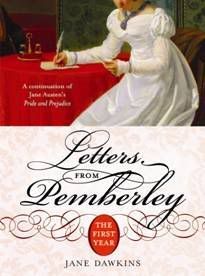
Photo Sharing and Video Hosting at Photobucket

As the title implies, Letters From Pemberley: the First Year is a series of twenty-five letters from the new Mrs. Darcy (aka Elizabeth Bennet) to her sister, the new Mrs. Bingley (aka Jane Bennet). Readers of Pride and Prejudice will remember that a letter played an important part in changing Elizabeth's feelings about Darcy, so Dawkins choice of letters as her medium fits quite well.

Dawkins described her work as "an old-fashioned patchwork quilt, where in place of the scraps of fabric . . . there is a line or a phrase or a sentence from one of Jane Austen's books or letters stitched alongside the lesser scraps" of Dawkins' work. She also took favorite characters from other Austen novels, gave them different names, and worked them into Lizzie's letters. It was very amusing to pick out who was who or which lines were from which books or letters (I even kept a little list! It is quite gratifying to figure these things out!).

I quite enjoyed Letters From Pemberley: the First Year and was glad that Dawkins did not feel the need to make Lizzie, Darcy, Jane, Bingley, Georgiana, and other characters new again. We read Jane Austen novels repeatedly because Jane created such realistic and fabulous characters. I think too often people try to "improve" upon them, which just cannot be done. Dawkins also understands this and wrote these letters in Lizzie Bennet Darcy's persona, not some other Lizzie's. I can easily imagine Jane having written these herself.

Lizzie is adjusting to life as mistress of Pemberley and wife of Mr. Darcy, attempting to develop a deeper relationship with Darcy's sister, Georgiana, and find her place in a higher level of society than she is used to living in. As much as her family drove her crazy on occasion, she misses being with them. Her letters to Jane describe her activities, her feelings, and her hopes.

Elizabeth and Jane are closest to each other out of the five Bennet daughters and their letters provide solace as they make their ways in their new lives. I can imagine doing the same with my sister (if she wrote letters).

I look forward to reading Letters From Pemberley: the First Year again (and figuring out more of Jane's lines!) and would recommend it to any Austen fan! You can find it at any bookstore. Do pick up a copy and let us know what you think!

Book Information: Letters from Pemberley: The First Year by Jane Dawkins (ISBN: 978-1-4022-0906-2; May 2007; $13.95 U.S./ $17.95 CAN; paperback)

My thanks to Cathy at Sourcebooks, Inc.!

Friday, July 27, 2007

Book Review: Old Friends and New Fancies

At the end of June, I received an e-mail from Cathy, of SourceBooks, Inc., a publishing company, asking if I would like to receive a couple of Jane Austen-ish books and review them on this blog. I first wrote about these books here.

The first book I read is actually the first Jane Austen sequel, written by Sybil G. Brinton and published in 1914. Old Friends and New Fancies has just been re-published for our reading pleasure. This novel is subtitled "An Imaginary Sequel to the Novels of Jane Austen." That's right: novels---plural.
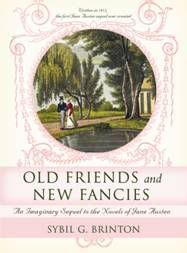
Photo Sharing and Video Hosting at Photobucket

Brinton cleverly used characters from Jane Austen's six finished novels in her story, easily creating acquaintances, friendships, and even romances. Most of our old favorites are included and a good number of characters who remained unattached at the end of their novels play large roles. Brinton focused mainly on Colonel Fitzwilliam, Kitty Bennet, and Georgiana Darcy from Pride and Prejudice; Tom Bertram, Mary Crawford, and William Price from Mansfield Park; and James Morland from Northanger Abbey. Mr. and Mrs. Darcy, Mr. and Mrs. Bingley, Captain and Mrs. Wentworth, Mr. and Mrs. Edward Ferrars, Mr. and Mrs. Knightley, and numerous other characters make large and small appearances. The setting is mainly Bath, Pemberley, and the Bingleys' estate. Who wouldn't want to go back to Pemberley?

I quite enjoyed reading Old Friends and New Fancies, not least because I was able to meet some of my favorite characters again and visit beloved places such as the Darcys' estate. In the past, I have been wary of reading Jane Austen sequels for fear that the author has taken liberties with the characters and made them behave as they would not. Rest assured, Brinton did no such thing. Her writing style is rather similar to Jane's and I was always delighted to read lines that sounded so like the great Jane's own. For instance, this exchange between Mr. and Mrs. Darcy seems right in line with what Jane might have written:

Mr. Darcy: ". . . we have got into shocking ways since my wife married into the family."
Mrs. Darcy: "On the contrary, I think I have educated you all admirably."
Or this exchange between the irasible Lady Catherine de Bourgh and Elizabeth Darcy:

Elizabeth: "We have all been enjoying your piece so much. It must be delightful to be able to play like that. My aunt is such a lover of music that she cannot hide her enthusiasm."
"And why should I hide it, may I ask?" demanded Lady Catherine. "My judgment has often been of great service to young amateurs, among whom you might include yourself, Elizabeth."
"Yes, I know," replied Elizabeth, good-humouredly . . ."
That is just how I imagine Elizabeth would get along with Lady Catherine, once Elizabeth had established herself as Mr. Darcy's wife and mistress of Pemberley, and made it clear to Lady Catherine that she would not be trifled with.

Old Friends and New Fancies is full of delightful little moments that remind the reader of Jane's beloved novels. It is amusing to try to figure out who will end up with whom!

I am glad to have read Old Friends and New Fancies and would recommend it to any Jane Austen fan. I hope you will pick up a copy at any bookstore and let us know what you think.

Book Information: Old Friends and New Fancies: An Imaginary Sequel to the Novels of Jane Austen by Sybil G. Brinton (ISBN: 978-1-4022-0888-1; July 2007; $14.95 U.S./$19.95 CAN; Paperback)

My thanks to Cathy at Sourcebooks, Inc.!

You can also find more Jane Austen inspired books by visiting AustenFans.com.

In the next few days I will post another review about the second book Cathy sent me: Letters From Pemberley: the First Year.